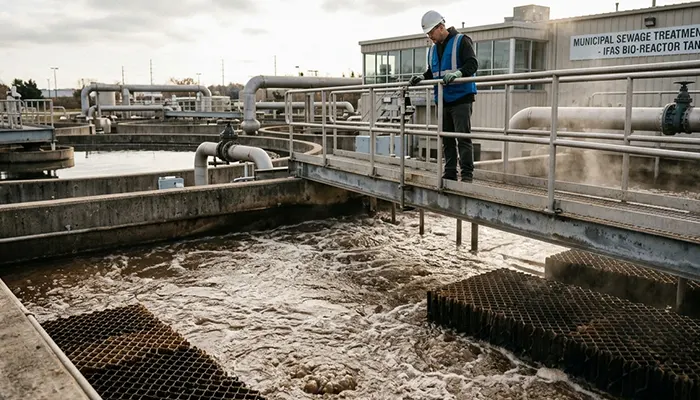
Improve biological treatment capacity in sewage treatment plants without expanding footprint
Sewage treatment plants are operating under increasing hydraulic loads, variable influent quality, and stricter discharge standards. These challenges require process upgrades that improve performance without expanding existing infrastructure.
At Awatech Solutions Pvt Ltd, we implement IFAS technology in sewage treatment plant systems to enhance biological treatment efficiency. This IFAS system combines suspended growth and attached growth processes, increasing active biomass and improving load handling capacity.
The integrated process enables higher treatment efficiency, better nutrient removal, and consistent effluent quality, making it suitable for both new installations and existing STP upgrades.
Evaluate IFAS suitability and identify the right upgrade approach.
How IFAS Technology Works in Sewage Treatment Plants
IFAS (Integrated Fixed-Film Activated Sludge) technology works by combining suspended growth and attached growth in a single treatment system. This hybrid biological process increases biomass concentration, improves treatment efficiency, and enables stable performance under varying load conditions.
Key components include:
Media Integration within the Aeration System
Biofilm media is introduced into the aeration tank to enable attached growth alongside suspended biomass. Retention systems keep the media contained while maintaining uniform distribution.
Aeration and Mixing for Effective Contact
The aeration system is designed to maintain optimal dissolved oxygen levels while ensuring continuous movement of media. This enables effective contact between wastewater, microorganisms, and oxygen for efficient treatment.
Combined Biomass for Higher Load Handling
By integrating suspended sludge and attached biofilm, the IFAS process significantly increases total biomass concentration, allowing the system to handle higher organic loads without performance drop.
Nutrient Removal within the Same System
We configure the process to support nitrification and denitrification, enabling effective nitrogen removal without the need for separate treatment stages.
Flexible Integration into Existing and New STPs
The IFAS system can be implemented in existing aeration tanks or incorporated into new sewage treatment plant designs, minimizing civil modifications and ensuring easy scalability.
Where IFAS Technology is Used in Sewage Treatment Plants
We implement IFAS technology in sewage treatment plant systems where higher biological capacity, process stability, and nutrient removal are required without increasing plant footprint. It is especially suitable for both existing plant upgrades and new compact system designs.
Typical scenarios include:
Inconsistent Influent Characteristics
Variations in organic load or flow impact process stability. IFAS improves resilience by supporting both suspended and attached growth, maintaining consistent performance.
Stricter Discharge Requirements
Meeting tighter norms for BOD, COD, and nutrients often requires process enhancement. IFAS supports improved nitrification and denitrification without major system changes.
Retrofit and Upgrade Requirements
In existing plants, IFAS is integrated into aeration tanks to enhance performance without significant civil modifications.
Space-Constrained New Sewage Treatment Plants
In urban or industrial projects where space is limited, IFAS enables higher treatment efficiency within a compact footprint, making it ideal for modern STP design.
What IFAS Technology Solves in Sewage Treatment Plants
IFAS technology addresses key performance and operational challenges in sewage treatment plants by increasing biological capacity, improving stability, and enhancing nutrient removal without requiring major infrastructure expansion.
Higher load handling without expansion
Increase treatment capacity within existing tank volume, avoiding additional civil infrastructure.
Stable performance under variable conditions
Maintain consistent effluent quality despite fluctuations in flow and organic load.
Improved nitrogen removal
Enable effective nitrification and denitrification to meet stricter discharge norms.
Reduced footprint requirements
Enhance process efficiency without increasing plant size, suitable for space-constrained sites.
Lower upgrade cost and faster implementation
Improve performance through process integration rather than full system replacement.
Better process reliability
Support consistent biological activity, reducing the impact of operational variations.
Why Choose Awatech for IFAS Technology
Awatech Solutions delivers IFAS technology in sewage treatment plant projects with a focus on process performance, reliability, and long-term operational efficiency. Our approach combines engineering expertise with practical execution to ensure consistent treatment outcomes.

15+ years of experience

350+ projects delivered

100+ successful installations

430+ clients served
Each project is supported by capabilities that strengthen design and execution:
- Real-time monitoring for process control and performance tracking
- Optimized media selection and aeration design for stable operation
- Process-led execution from system integration to commissioning
- EPC capability covering engineering, procurement, and construction
Applications of IFAS Technology Across Sectors
IFAS technology is widely used in sewage treatment plants across multiple sectors where consistent treatment performance, space efficiency, and regulatory compliance are critical. Its flexibility makes it suitable for both new installations and existing system upgrades.
Municipal STPs
Capacity enhancement and compliance with tightening discharge norms
Commercial and Residential Developments
Compact treatment systems for space-constrained urban projects
Industrial Facilities
Handling variable loads and improving biological treatment stability
Infrastructure and Institutional Projects
Reliable wastewater treatment for campuses, utilities, and public systems
Frequently Asked Questions
Q1: What is IFAS in wastewater treatment?
IFAS (Integrated Fixed-Film Activated Sludge) combines suspended sludge and biofilm carriers in a single system to enhance biological treatment performance. It is widely used in sewage treatment plants for capacity upgrades and improved process stability.
Q2: What is the difference between IFAS and MBBR?
IFAS retains both suspended and attached biomass, while MBBR operates only with biofilm carriers and does not maintain return activated sludge.
Q3: Does IFAS require changes to secondary clarification?
In most cases, existing clarifiers are retained, with checks to ensure they handle increased biomass levels.
Q4: What factors influence IFAS media selection?
Media type depends on tank configuration, treatment goals, hydraulic conditions, and required surface area for biofilm growth.